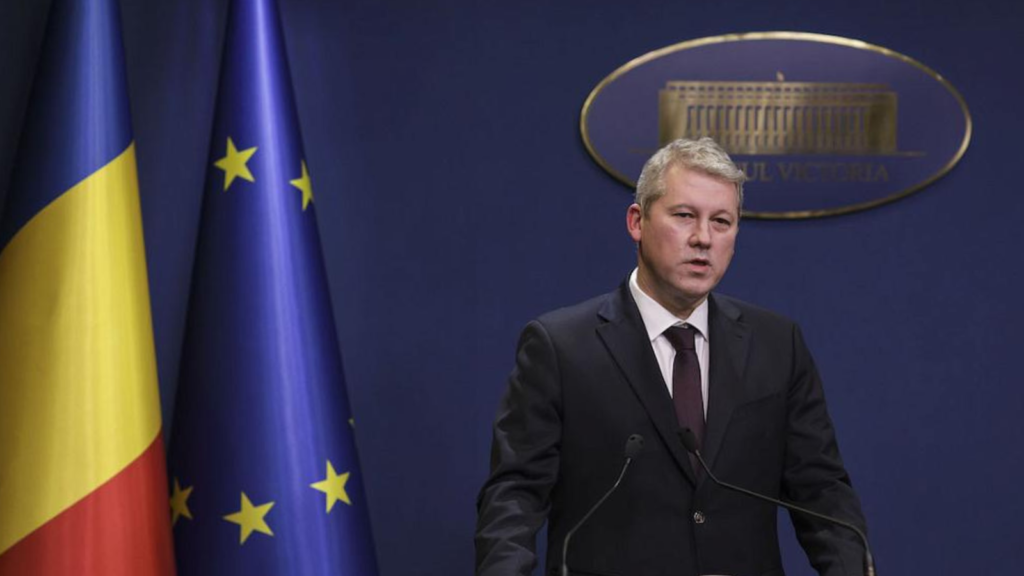
Romania's Interior Minister and former Justice Minister Cătălin Predoiu published a candid essay today reflecting on one of the most turbulent moments in Romania's recent parliamentary history. Writing on his personal blog, Predoiu — who received Alianta's 2025 International Public Service Award — explains why he voted in favor of a proposed government despite knowing it would fail, and what he believes the country's political class owes to the public interest in moments of institutional crisis.
Read the translation below, and the original post at the link.
Politics is the Art of the Possible
By Cătălin Predoiu | June 24, 2026
Originally published at predoiupolitica.ro
For more than a month, I and other PNL colleagues have consistently argued that the party must participate in government, because Romania needs a fully empowered, functional government — and that's difficult to achieve without PNL. PNL is the solution to the political crisis, not AUR. Financial markets and the business environment could run out of patience, and the prolonged uncertainty has generated costs and risks we simply could not afford.
Throughout this time, the party repeatedly discussed and voted on the idea that PNL should not continue governing alongside PSD, and that a period in opposition would be the best option for the party's future. That position was backed by the leadership and a majority of colleagues. My own conviction, however, was different: in difficult moments for the country, responsibility toward the public interest must take precedence. Other colleagues said the same. The way things developed put some of us in front of a difficult dilemma — act on the conviction that the country urgently needs a government, or subordinate that conviction to a party directive.
All the more reason I watched with interest the shift in approach over the last few days, when the PNL leadership decided to support the formation of a new government. Beyond the political calculations inherent to any party, what matters is that a step forward was taken — toward breaking the deadlock and sending a signal of stability to society and to the markets. (It remains a paradox, however, that those who voted for a government that included liberals are considered suspect of disloyalty, while voting for a purely PSD government — even with conditions attached — is apparently acceptable.)
I voted for the proposed government two days ago because it represented a solution that could have closed a period of uncertainty and set state institutions back in motion. In consolidated democracies, parties take on both the role of governing and that of opposition — but there are defining moments and exceptional circumstances that call for actions that go beyond the usual calculus of party self-interest. Last year was the same, when the pro-Western coalition was formed from parties that had traditionally been political adversaries.
I chose to remain consistent with my conviction that Romania urgently needed a government and that this objective had to take priority. Other colleagues acted similarly. It was not a conspiracy against PNL, but a spontaneous political expression aimed at salvaging the situation with a government that also included a few liberals. It was a choice of prioritization, not subversion — putting a general interest ahead of a specific party interest.
When I cast my vote, I already knew the government would not pass, because there were not enough votes in the chamber. But I chose to underscore, one more time, the country's need for a government. I knew my vote could not contribute to validating a government, because the numbers weren't there. The other PNL colleagues who voted in favor understood the same. By the time the vote began, it was clear the government was as good as rejected. We could have abstained and avoided an uncomfortable conversation with the party — but we chose to make our position known to the end. It's true that, implicitly, we also made a choice about our future, given the party's stance. For my part, I am prepared to accept the consequences. I am asking nothing of anyone. I will not contest a potential decision by the party to expel me. I will take it as it comes, without comment, and will continue my public activity under the circumstances.
At the same time, I believe that colleagues who wish not to face sanctions — and say so openly — deserve the chance for dialogue and compromise with the party, on terms that are reasonable for both sides. And not merely as an interlude until the new party statute is approved, only to then be pushed out or permanently sidelined and dismissed. Here is a complex challenge for the party's Secretary General: how to find a political solution in a complex situation that requires reconciling directives, principles, and seemingly irreconcilable positions. It's a bit more complicated than simply urging the party to expel people. It resembles a diplomatic file I once handled — apparently unsolvable. I am confident the Secretary General will find a resolution.