Written by Catalin Predoiu.
The article is translated from Romanian as it was originally published on https://predoiupolitica.ro/romania-risca-sa-piarda-trenul-noii-harti-economice-a-europei/
Due to the absence of a fully mandated government, Romania is losing its chance to become an essential player along the major connectivity corridors reshaping the continent.
In the global competition for commercial, energy, and logistics routes, Romania sits at a critical juncture. Its geographic position — at the intersection of the Black Sea, Central Europe, the Middle East, the South Caucasus, and Central Asia — gives it a real shot at becoming one of Europe's primary connectivity hubs.
Without a stable government with full political legitimacy, Romania's capacity to negotiate, promote, and implement strategic projects is severely diminished — precisely when Brussels and Washington are redrawing the Eurasian corridor map. If nothing changes, Romania risks being reduced to a peripheral transit country, or worse, bypassed entirely.
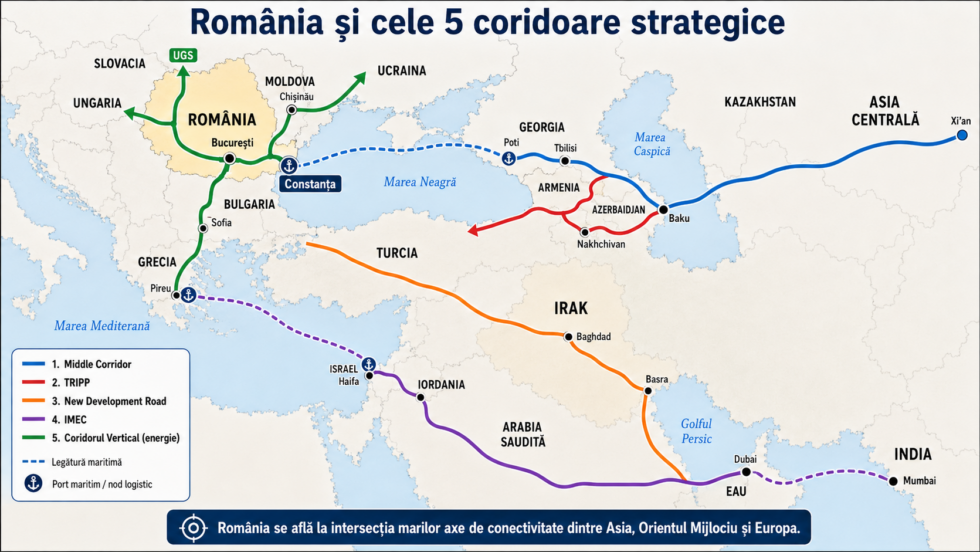
1. The Middle Corridor
The Middle Corridor is the primary alternative to Russia-transiting trade routes connecting Europe to Asia. It links China and Central Asia to Europe via the Caspian Sea, the Caucasus, and the Black Sea.

Romania's Port of Constanța could become the main EU entry and exit point for goods arriving from or heading to Central Asia through Azerbaijan, Georgia, and the Black Sea.
Greater Romania-Bulgaria interconnectivity could also position Romania as the key country for freight along the southern branch of this corridor — continuing from Georgia through Turkey and Bulgaria. Currently, due to infrastructure gaps and insufficient connectivity, significant freight flows are routed from Bulgaria through Serbia to Hungary, despite Serbia not being an EU member. That route is longer but, under certain logistical conditions, faster.
In parallel, projects like the Georgia-Romania submarine energy cable — to which Azerbaijan and Central Asian states want to connect in order to supply green energy to Europe — could turn Romania into a gateway for Caspian energy flows as well.
2. The TRIPP Corridor (Trump Route for International Peace and Prosperity)
This corridor connects Azerbaijan to Armenia and to the Azerbaijani exclave of Nakhchivan. It emerged from the historic peace agreement signed at the White House on August 8, 2025, facilitated by President Trump, who mediated negotiations between Azerbaijan and Armenia and pushed for economic and connectivity components designed to make normalization a driver of regional development.
Related to both this and the Middle Corridor: American presence in Georgia has grown considerably in recent months. U.S. investments in Georgia's Poti port and discussions around the deep-water Anaklia port are both in motion.
The natural counterpart to Georgia's Black Sea ports, on the western shore, is Constanța.
3. The New Development Road (Persian Gulf – Iraq – Europe)
A transport corridor under construction through Iraq, connecting the Persian Gulf to Turkey and onward to Europe or Central Asia via the South Caucasus.
Given tensions in the Middle East and risks around the Strait of Hormuz, this corridor is gaining strategic weight fast.
4. IMEC — India–Middle East–Europe Economic Corridor
A U.S.-backed corridor linking India to Europe through the UAE, Saudi Arabia, Jordan, and Israel — designed to reduce dependence on traditional maritime routes through the Bab el-Mandeb Strait and the Suez Canal.
As EU-India strategic and economic ties deepen, IMEC is increasingly viewed by Western governments as one of the most important geo-economic projects of the coming decades. France and Italy have each appointed a dedicated special envoy for IMEC alone.
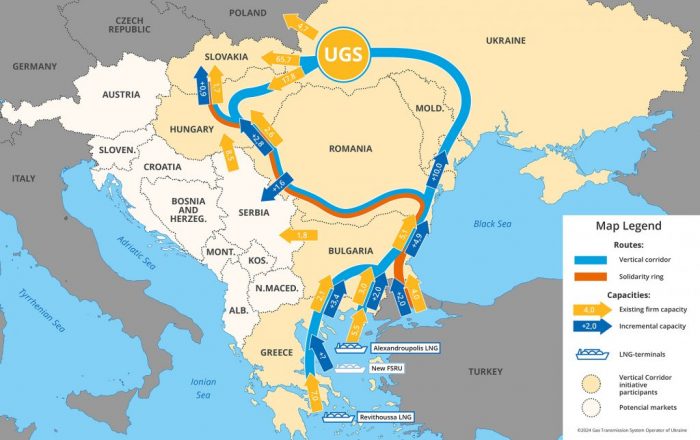
5. The Vertical Corridor
An EU- and U.S.-backed corridor linking the Mediterranean — through Greece — to Bulgaria, Romania, Ukraine, and Moldova.
The Convergence Point Is Romania
Across all five corridors, one factor is constant: they all converge on the Black Sea basin.
Romania is the only EU member state that combines a strategic Black Sea position, a high-capacity port in Constanța, the Danube-Black Sea Canal, direct access to the Danube (the cheapest trans-European freight artery), full single market access, and the geographic ability to channel goods, energy, and data flows toward Central and Western Europe.
That combination is rare on the continent. It represents a historic opportunity to become the primary connectivity hub between Europe, the Caucasus, Central Asia, and the Middle East.
Capturing it requires political will, accelerated investment, and an active seat at the negotiating table.
Romania isn't just losing time while a new government forms. It risks losing its positioning in a generation of projects that will define how goods, energy, and capital move between Asia, the Middle East, and Europe for decades.
In geopolitics, windows don't stay open. If Romania delays, other regional logistics nodes will absorb the flows.